

It’s no secret that most enterprise AI projects fail before they reach production. In fact, according to MIT, 95% of AI projects fail to deliver on their promises. Not because the models don't work, but because assembling models, data, integrations, and governance into a working solution takes too long, costs too much, and entails more complexity than most anticipate.
And the gap between AI capability and AI deployment keeps widening. Custom builds stretch timelines, while point solutions solve narrow problems but don't adapt to adjacent use cases.
AI blueprint architectures offer a third path. Instead of building from scratch or settling for rigid tools, blueprints configure pre-built components into tailored solutions. This enables you to cut deployment from months to days, while also minimizing cost and complexity.
Why traditional AI architecture approaches fail
Enterprises typically choose between the aforementioned paths when deploying AI. Each creates its own set of problems. Let’s explore each to uncover the hidden pitfalls associated with each.
The custom build trap
The average enterprise AI project takes 12 to 18 months from concept to production. That's not because the AI is hard. It's because everything around the AI is hard.
The majority of development time gets consumed by integration and infrastructure work, not building AI capabilities. Teams spend months connecting systems, managing data pipelines, implementing security controls, and building the scaffolding that lets AI actually function in a production environment.
And the unfortunate result of all this is more risk. Custom deployments are synonymous with knowledge concentration. A small group of specialized engineers understands how everything connects, and when they leave, institutional knowledge leaves with them.
The point solution ceiling
Point solutions promise quick wins. Deploy a specialized tool, get immediate value. The problem emerges when the next use case arrives.
Most point solutions solve one problem well but can't adapt to adjacent needs. Your data flows into their system. Your workflows adapt to their structure. But when requirements evolve, you're stuck with what the vendor's roadmap delivers, not what your business needs.
Each point solution creates its own data silo, its own integration logic, its own maintenance burden. An AI blueprint architecture addresses these failures by separating what you need from how it gets built.
The components of an AI blueprint architecture
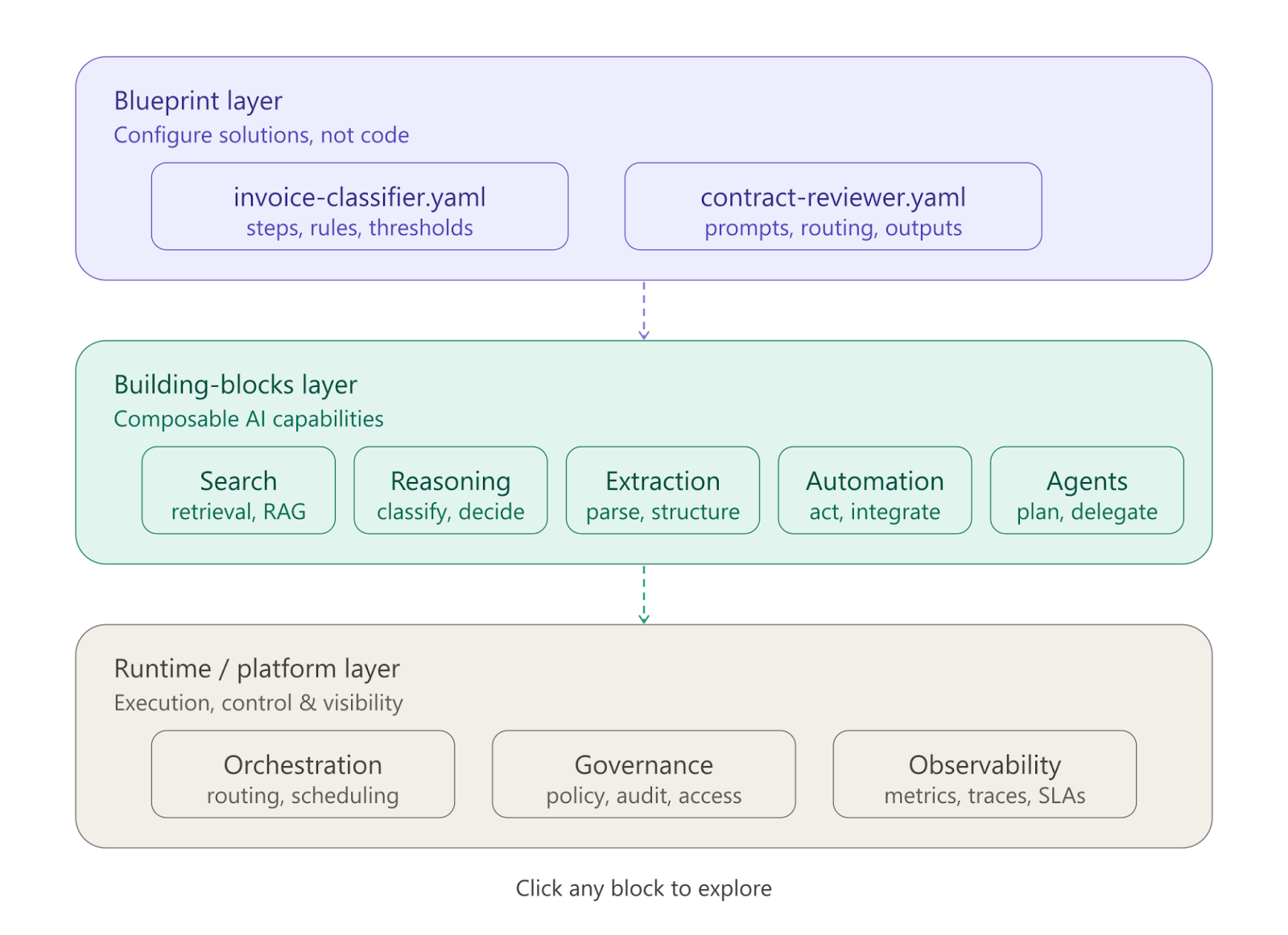
Blueprint architecture consists of three layers that work together: building blocks, the configuration layer, and the runtime layer.
The key insight is that the same building blocks (search, reasoning, extraction, automation, agents) can be configured into completely different solutions. The blueprint is the difference between a document extraction system and a knowledge search assistant, even though both might use the same underlying components.
Let’s take a look at each layer and what they consist of so you’re aware of how everything works together.
Building blocks layer
Building blocks are the modular, reusable components that blueprints orchestrate. Each block handles a specific AI function and can be combined with others to create complete solutions.
Search and retrieval finds relevant information across structured and unstructured data, but it goes well beyond keyword lookup. This block includes pre-built connectors for APIs, databases, and document stores, along with extract-index pipelines that handle both batch and streaming ingestion.
Under the hood, it supports multiple embedding and index store options, from vector databases to hybrid indexes, with ranking logic that adapts to the query context. Every retrieved result carries provenance metadata, so things like the source system, document offset, and confidence score. That traceability means downstream processes can always point back to the exact snippet that informed a decision. When a regulator asks "where did this number come from," the answer is already embedded in the output.
Reasoning and analysis applies logic to compare, evaluate, and synthesize information across multi-step problems. This block operates through a managed model pool and orchestration layer that runs chains of thought, multi-step pipelines, and domain-specific adapters. Ensemble logic handles model selection and confidence fusion, so the system can route a task to the right model or combination of models based on complexity and domain.
Every decision is tagged with metadata, including the model version, prompt template, and cost. That level of attribution makes each reasoning step explainable and reproducible. When compliance teams ask how the system arrived at a recommendation, the full chain of logic is already documented, not reconstructed after the fact.
Extraction and structuring transforms unstructured content like contracts, reports, and emails into usable, typed data. This block combines deterministic parsers (OCR, regex, table extraction) with ML-driven named entity recognition and schema mapping. Outputs are strongly typed and tied to source spans, meaning every extracted value links directly to the originating evidence in the document.
That linkage closes the gap that kills most extraction projects in regulated industries. When a number in a downstream system doesn't match the source document, teams can trace it back to the exact clause, cell, or paragraph it came from. No manual reconciliation. No ambiguity about what the system read.
Automation and orchestration connects reasoning to action in downstream systems. It functions as a workflow engine that maps reasoning outputs to concrete operations like API calls, database updates, ticket creation, email triggers, and task routing. This block includes retry logic and compensating transactions for fault tolerance, along with pre-built connectors for common enterprise platforms.
Every action embeds provenance and policy checks, making the entire execution chain auditable and, when necessary, reversible. This is the difference between automation that works in a demo and automation that survives a controls review. Governance isn't layered on after deployment. It's in the execution path from day one.
Agents combine multiple building blocks with decision logic to complete tasks end to end. They operate under a policy engine that defines guardrails. Things like what the agent can do autonomously, what requires escalation, and what's off-limits entirely. For high-confidence tasks, agents execute without interruption. When confidence drops below threshold, they route to human queues through a built-in human-in-the-loop interface.
The result is autonomous execution where it's safe and human oversight where it matters, with full traceability across every step the agent took. That's the bar enterprise teams should set for any agentic system. Not just "can it complete the task" but "can we explain and defend every action it took.
Each block is independently developed, tested, and improved. Enhancements to one block benefit every solution that uses it.
Configuration layer (blueprints)
A blueprint is a configuration specification that defines how AI components combine to solve a specific problem. Think of it as the recipe, not the ingredients.
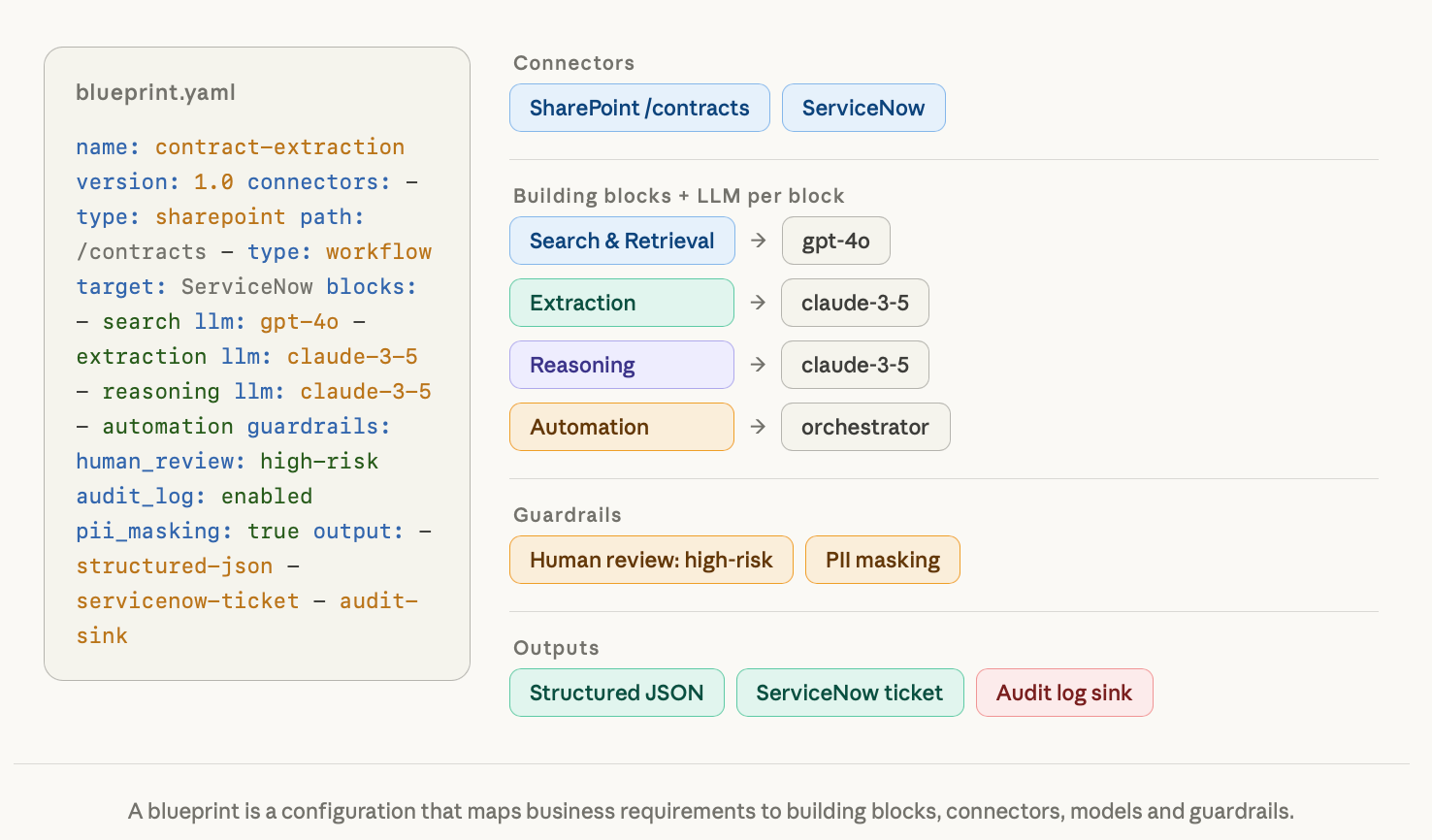
Blueprints specify:
- Which AI components (building blocks) a solution needs
- How those components connect and interact
- What data sources to access
- What governance rules to enforce
- What outputs to produce and where to deliver them
Think of it like architectural blueprints for buildings. The materials exist: steel, glass, concrete. The construction methods are known. What makes each building different is the blueprint that specifies how materials combine for a specific purpose.
An office tower and a hospital use similar materials but serve entirely different functions because the blueprints differ.
Unframe’s Blueprint Templates are productized blueprints for common industry workflows - prewired connectors, extraction schemas, governance defaults, and example outputs that ship with test fixtures and observability. Unframe imports a template (e.g., lease extraction, claims triage, or finance risk monitor), maps customers’ sources, tweaks governance gates, and runs in days. Templates reduce time-to-value, standardize best practices, and provide a safe, auditable starting point for customization.
Runtime layer
The platform interprets blueprints and executes solutions. It orchestrates component interactions, manages data flow between blocks, enforces governance policies, handles scaling and performance, and provides observability and audit trails.
This separation of concerns is what makes blueprint architecture powerful. Business requirements live in the blueprint. Technical execution lives in the platform. Neither needs to change when the other evolves.
Governance, traceability & audits
Unframe enforces governance at both design time and runtime. Blueprints declare policy constraints (data access rules, allowed models, approval gates) that the runtime enforces automatically. Every inference and action carries metadata - model version, prompt, input tokens, confidence score, and source spans - and is written to an immutable audit trail for compliance, forensics, and explainability.
Security, privacy & deployment options
For regulated enterprises, Unframe supports flexible deployment topologies - cloud, dedicated tenancy, or hybrid/on-prem proxies that keep sensitive sources behind customer firewalls. All connectors and transport channels support encryption in transit and at rest, tokenized access, and per-tenant key management (including BYOK/KMS integrations). Runtime policies enforce data-residency constraints and PII masking hooks before any model or third-party service sees data. These controls are complemented by RBAC, SSO/SAML/OIDC identity integrations, plugin signing, and audit exports so teams get enterprise-grade privacy and operational control without sacrificing speed of deployment.
Observability & SLOs
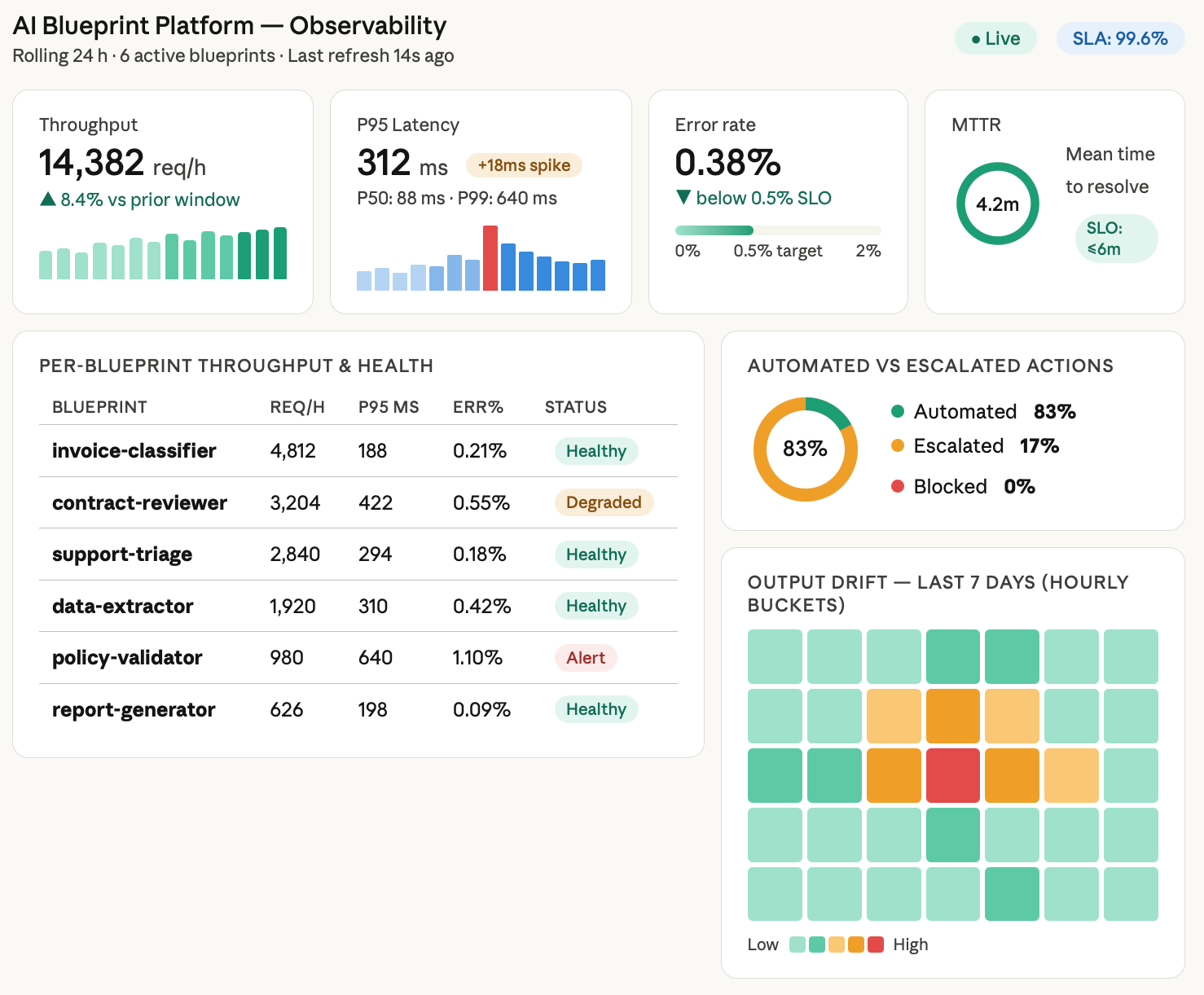
Observability is first-class. The platform emits telemetry for pipeline latency, model costs, action error rates, automated vs escalated actions, and provenance sampling. Blueprints can declare SLOs (latency, correctness thresholds) and the runtime auto-notifies owners when SLOs degrade.
KPIs include:
- Time-to-insight (ms / s)
- Percent automated actions vs escalated
- Precision/recall or correctness by blueprint
- MTTR for failures and incident rate
- Drift alert rate & model rollback events
Model & Data Ops
Operationalizing models requires more than hosting - it requires versioning, metrics, drift detection, canarying, and rollback. The platform includes a model registry and model-ops pipeline that lets teams register models, run synthetic tests, and route traffic by performance or cost.
- Model registry with versioning and rollout controls
- Canarying and A/B for model updates, with automatic rollback on SLA breaches
- Drift detection (data & concept) and alerting tied to blueprint owners
- Cost controls: model selection by cost/latency SLOs
Extensibility & developer surface
Unframe is configurable for non-engineers but intentionally extensible for engineers. The platform exposes SDKs and a plugin model so teams can add custom connectors, bespoke extractors, or proprietary scoring functions without changing core platform code. Plugins are first-class citizens - they register with the runtime, emit provenance and telemetry, and are validated by a built-in test harness that runs new blocks against production-like fixtures. This approach preserves rapid configuration for business users while giving engineering teams safe, auditable extension points for advanced customization.
AI blueprint architecture vs agentic frameworks
Technical audiences often ask how blueprint architecture compares to agentic frameworks. The question matters because both approaches promise modular AI, but they solve different problems for different teams.
What agentic frameworks actually provide
Agentic frameworks are developer toolkits. They give you primitives like LLM wrappers, memory management, tool calling, chain orchestration, and agent communication patterns. You write code to combine these primitives into working systems.
The value proposition is control. You decide how agents communicate. You define the memory architecture. You choose which models power which tasks. You own the orchestration logic.
The hidden cost is that you also own everything else. Production hardening, governance, security, scaling, observability, error handling, version management, etc. These become engineering problems your team builds and maintains. The framework gives you building materials but you're still constructing the building.
What blueprint architecture provides
Blueprint architecture operates at a higher abstraction level. Instead of writing orchestration code, you configure specifications that define what you need. The platform interprets those specifications and handles execution.
The value proposition is speed and governance. You define outcomes. The platform handles how agents coordinate, how data flows, how governance enforces, and how the system scales. Components are pre hardened for production. Observability is built in. Security isn't your problem to solve.
The constraint is that you work within the platform's capabilities. You can configure extensively, but you can't fundamentally redesign how components interact. If the platform doesn't support a capability, you wait for the vendor or work around it.
The real tradeoff: where complexity lives
The choice isn't flexibility vs speed. It's where you want complexity to reside.
With agentic frameworks, complexity lives in your codebase. Your team understands every line. You can modify anything. You're also responsible for everything breaking.
With blueprint architecture, complexity lives in the platform. You configure rather than code. You deploy faster. You also depend on the vendor's engineering and roadmap.
Neither is inherently better. The question is which tradeoff fits your situation.
Choosing the architecture that scales
Leveraging an AI blueprint architecture bridges the gap between custom development and rigid point solutions. By separating what you need (the blueprint) from how it gets built (the platform), you can deploy tailored AI in days instead of months.
The building blocks approach means components improve independently. The blueprint layer means solutions can be reconfigured without rebuilding. The platform layer means production concerns are handled, not inherited.
The question isn't whether to use AI. It's whether you can deploy it fast enough to matter. Blueprint architecture is how enterprises move from pilots to production without the traditional timeline.
Schedule a demo with us to see all of this in action!

Explore more blog posts from Unframe.