


AI Data Management

Connected, meaningful, and current data for production AI. Without manual prep.

The data preparation trap
Most enterprise AI projects die in data preparation. Not because the data doesn't exist, but because the approach to making it "AI-ready" is fundamentally misaligned with how production AI actually works.

The problem is that this foundation takes months to build, goes stale within weeks, and still fails to capture the business semantics that AI needs to reason effectively. Teams that have tried this approach know the pattern.

The adaptive data model requirement

To operate reliably in production, AI needs a data foundation grounded in an adaptive data model. One that resolves fragmentation, preserves shared semantics, and evolves as systems change. 
Connect data across fragmented systems to form coherent context
Organize shared business meaning so AI can reason consistently
Serve real-time, use-case-specific views for each AI application
Work with all your data as it changes
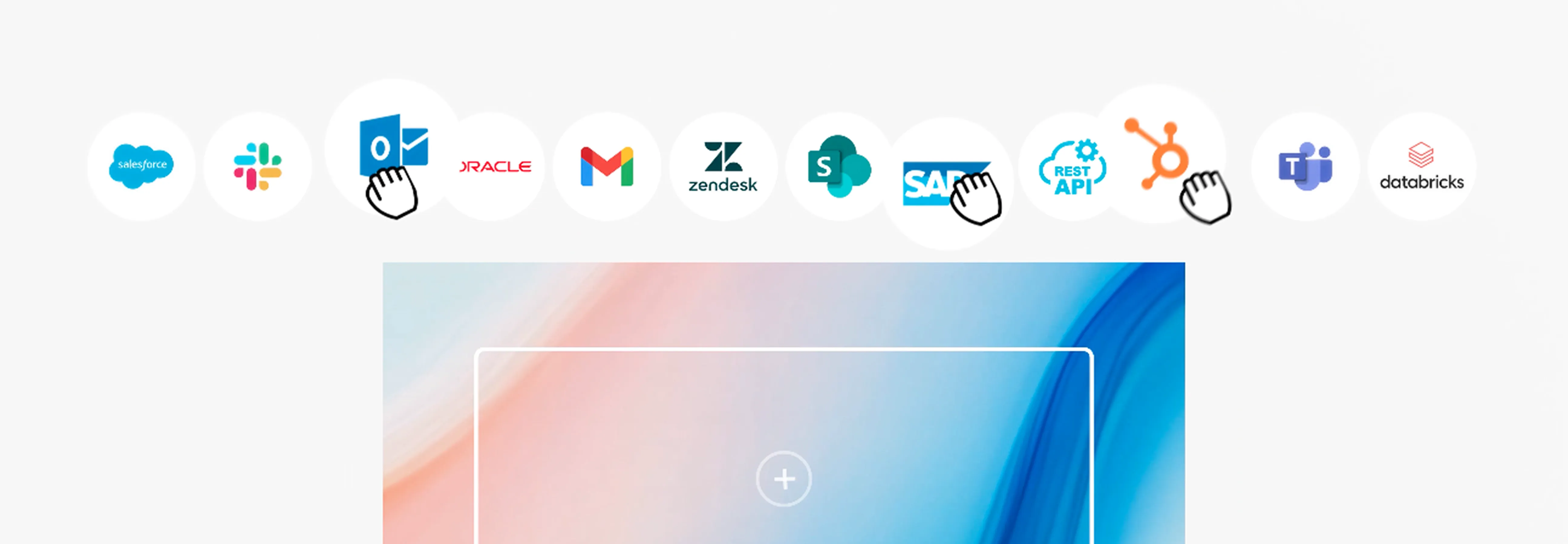
Unframe's data foundation takes a different approach. It continuously connects to data across your environment without centralizing or replacing existing systems.

This connected data layer becomes the foundation for enterprise search and knowledge retrieval. Instead of searching across disconnected silos, AI can access a unified view of information that spans your entire environment.
Prepare shared context for each AI use case
Raw connectivity isn't enough. Data extraction from source systems produces fragments, not context. The real challenge is organizing those fragments into structures that AI can reason over effectively.

Unframe approaches this by defining per-use-case data models in collaboration with customers. Rather than attempting a single universal schema that tries to represent everything, the platform builds context specific to each AI application. This is where data extraction and abstraction capabilities transform raw inputs into usable intelligence.
Deliver the right context at runtime
AI systems need fresh, relevant context at the moment of decision, not batch exports that were current when they were generated but stale by the time they're consumed.

Unframe serves context at runtime based on the defined use case. When an agent needs to answer a question, when an automation needs to make a decision, when a search query requires synthesis across multiple sources, the data foundation delivers exactly the context required for that specific request.
Governance that scales with AI adoption
AI data security isn't a feature you add after deployment. It's a structural requirement that must be embedded in the data foundation from the start. When AI systems access sensitive enterprise data, the permissions model becomes critical. Get it wrong, and you've created a vector for data leakage that scales with every AI application you deploy.

Unframe embeds governance directly into the data foundation so AI can scale safely without slowing teams down. Permission-aware access is inherited from source systems, meaning the access controls you've already defined in your databases, document repositories, and SaaS applications automatically apply to AI.

The foundation for Knowledge Fabric

By delivering federated, queryable, governed inputs, the data foundation creates what Knowledge Fabric needs to operate. Knowledge Fabric builds on this layer, creating a semantically linked, contextualized view that makes AI fluent in your business language.

The data foundation handles the mechanics

Connectivity, organization, governance, and runtime delivery

Knowledge Fabric handles the semantics

Understanding what terms mean in your specific context, how concepts relate to each other, and how to translate natural language into precise queries across your data landscape

Say the use case

Get a custom demo

Book a demo