


Overview
AI is transforming food safety traceability by enabling faster risk detection, real-time monitoring, and more accurate supply chain visibility. By deploying tailored AI solutions, organizations can improve compliance, reduce risk, and respond to issues proactively.
- AI enables real-time food safety monitoring and alerts
- Data integration improves traceability across supply chain systems
- Predictive models identify risks before issues escalate
- Automated workflows streamline compliance and reporting processes
- Tailored AI solutions improve speed and operational efficiency
Across global food supply chains, ensuring safety and transparency is paramount. Food safety traceability breaks down when visibility does. Across complex supply chains, data is fragmented, delayed, and often disconnected from the systems teams rely on to act. When an issue surfaces, the challenge goes beyond identifying it. It’s crucial to trace it quickly enough to limit impact.
Phase 1: Strategic Planning and Data Ingestion
Effective AI deployment begins with a clear understanding of your traceability needs and robust data handling. Rapid deployment hinges on efficient data pipelines.
Key considerations for data ingestion and planning
| Area | What to Focus On |
|---|---|
| Scope and objectives | Define the specific food safety risks you want to mitigate (e.g., contamination detection, origin verification, recall management) and the outcomes you expect. |
| Data source identification | Map all relevant data sources across the supply chain, including farm records, processing logs, transportation data, lab results, POS data, IoT sensors, and external signals like social media. |
| Data format and quality | Ensure data is cleaned, validated, and standardized across structured, unstructured, and semi-structured formats to avoid inaccurate model outputs. |
| Data ingestion strategy | Build a scalable, secure pipeline for real-time or near real-time ingestion using APIs, batch processing, or database integrations—often supported by cloud infrastructure. |
| Data security and privacy | Apply strong security controls and ensure compliance with relevant data privacy regulations to protect sensitive supply chain information. |
Phase 2: AI Model Development and Training
This phase involves building and refining the AI models that will power your traceability system. Speed here comes from leveraging pre-trained models and agile development practices.
Key considerations for AI model development and training
| Category | Focus Area | What to Consider |
|---|---|---|
| AI techniques | Machine learning (ML) | Use for anomaly detection, predictive analytics, and classification of food products and risks. |
| Natural language processing (NLP) | Analyze text-based data such as reports, incident logs, and consumer feedback to identify potential issues. | |
| Computer vision | Enable automated inspection of products for defects, contamination, or spoilage. | |
| Model development approach | Pre-trained models | Use pre-trained models for common tasks and fine-tune them with food safety data to accelerate deployment. |
| Custom model building | Build models from scratch for highly specific use cases requiring tailored performance. | |
| Data splitting | Divide data into training, validation, and testing sets to ensure accurate evaluation and avoid overfitting. | |
| Model training and iteration | Continuously train and refine models using performance metrics such as accuracy, precision, recall, and F1 score. | |
| Explainability (XAI) | Prioritize models that provide transparency, so teams understand why risks are flagged and can act with confidence. |
Phase 3: Integration with Existing Systems
For rapid deployment and maximum impact, the AI solution must seamlessly integrate with your current operational infrastructure.
Key considerations for system integration
| Area | What to Focus On |
|---|---|
| API-first design | Build the solution with robust APIs to enable seamless integration with ERP, WMS, SCM systems, and IoT platforms. |
| Data flow mapping | Define how data moves between existing systems and the AI solution, including how insights and alerts feed into operational workflows. |
| User interface and experience (UI/UX) | Design intuitive dashboards and interfaces so stakeholders can easily access insights, receive alerts, and take action. |
| Phased rollout | Start with a pilot in a specific area or product line, then scale to full deployment to reduce risk and ensure smoother adoption. |
Phase 4: Real-Time Monitoring and Alerting
The true power of AI in traceability lies in its ability to monitor continuously and alert proactively.
Key considerations for real-time monitoring and alerting
| Area | What to Focus On |
|---|---|
| Continuous data feed | Ensure the system continuously ingests and processes data to maintain real-time visibility across the supply chain. |
| Automated alerting system | Configure alerts for anomalies, risks, or deviations, with settings based on severity and relevant stakeholders. |
| Root cause analysis support | Provide contextual data and potential root causes alongside alerts to enable faster investigation and decision-making. |
| Visualization and reporting | Use real-time dashboards to track traceability, highlight risks, and generate reports for compliance and operational review. |
Phase 5: Ongoing Maintenance and Optimization
AI systems are not static. Continuous improvement is vital for sustained effectiveness.
Key considerations for ongoing maintenance and optimization
| Area | What to Focus On |
|---|---|
| Model performance monitoring | Continuously track model accuracy and effectiveness, and watch for data drift that can impact performance over time. |
| Data retraining and model updates | Regularly retrain models with new data to reflect changing supply chain conditions and improve accuracy. |
| System updates and patching | Keep infrastructure, APIs, and AI platforms updated with the latest security patches and software versions. |
| Feedback loop integration | Incorporate user feedback and real-world outcomes to refine models, alert thresholds, and system behavior. |
| Scalability planning | Ensure the AI infrastructure can scale with increasing data volumes and expanding operational complexity. |
Benefits of custom AI solutions for food safety traceability
Implementing a custom AI solution for food safety traceability delivers both operational and strategic benefits. By improving visibility across the supply chain and automating key processes, organizations can reduce risk, respond faster to issues, and make more informed decisions—without adding complexity to existing workflows.
Key benefits include:
- Proactive identification and mitigation of contamination risks
- Faster, near real-time traceability from origin to consumer
- Reduced waste through better forecasting and early detection
- Simplified compliance with automated data collection and reporting
- Increased consumer trust through greater transparency and accountability
- Improved operational efficiency and decision-making through automation and data insights
Skip the build - get a tailored FSMA 204 solution with Unframe
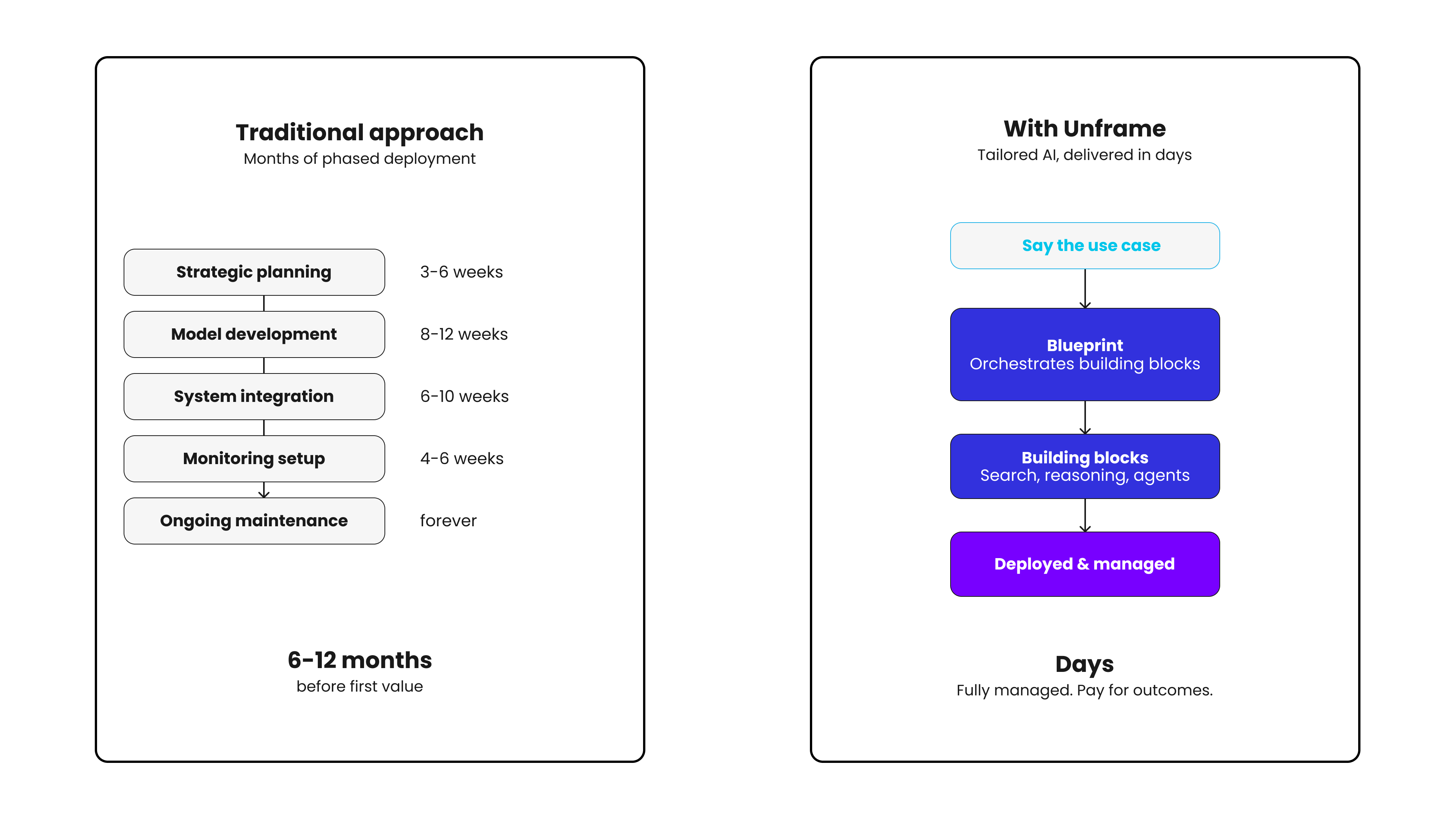
With Unframe, food safety teams don't need to plan, build, and manage custom AI in-house. We deliver a tailored FSMA 204 traceability solution that works within your company's unique complexities - your systems, suppliers, SKUs, and workflows. It's deployed in days, not months, fully managed by Unframe, and you only pay when you see real value.

Explore more blog posts from Unframe.