
Enterprise leaders are quickly realizing that the next phase of AI adoption isn’t about copilots, chat interfaces, or isolated task automation. The real opportunity lies in automating critical operations: the workflows that directly impact revenue, cost, compliance, and customer experience.
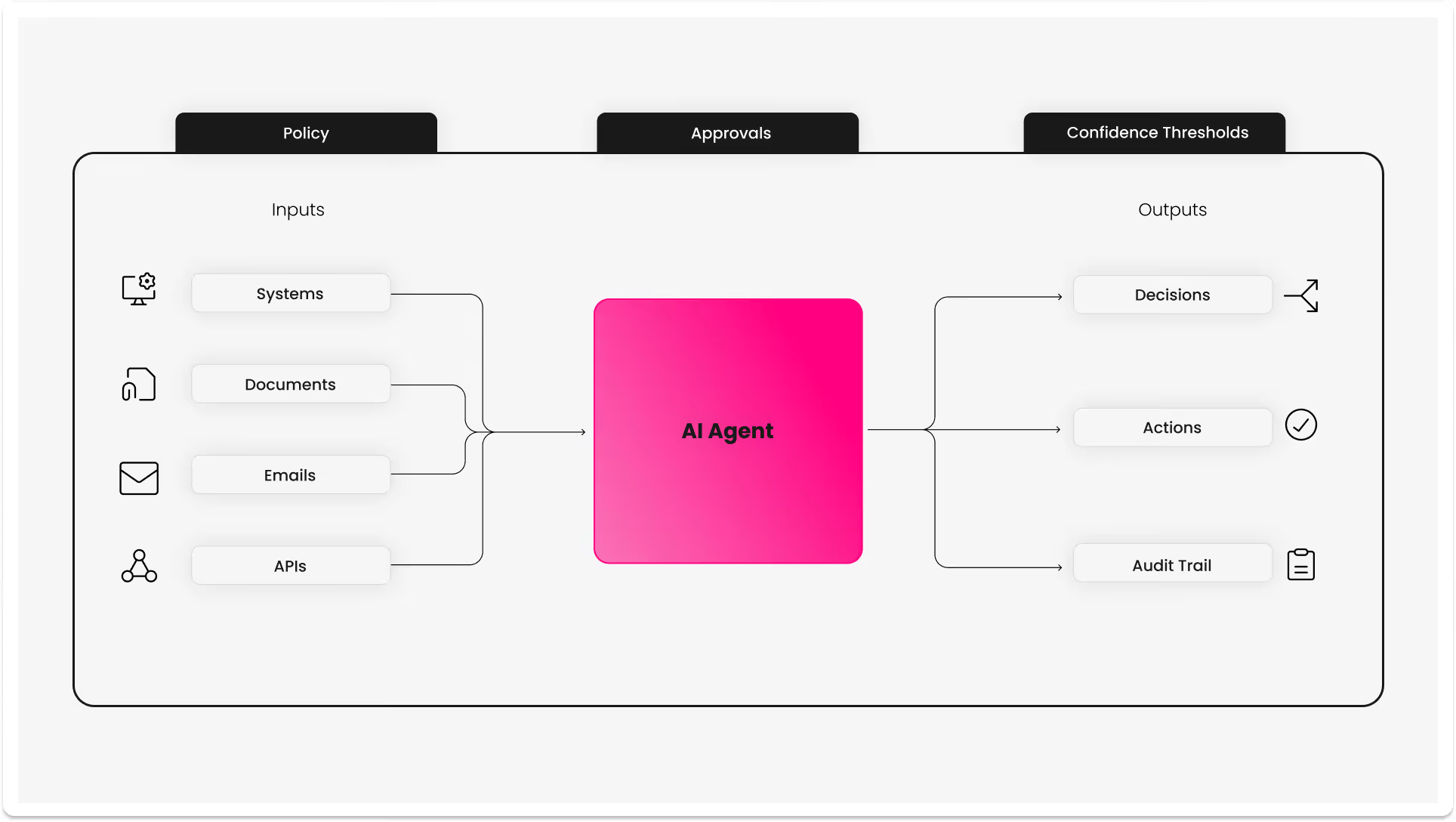
This is where agentic AI enters the picture. Unlike traditional automation or assistive AI, agentic systems are designed to take ownership of outcomes. They can reason through complex goals, plan multi‑step actions, operate across multiple systems, and adapt when conditions change — all while operating within clearly defined guardrails. In practice, that means AI can move beyond helping humans work faster to actually running end‑to‑end processes that previously required constant human judgment.
Not every workflow is ready for this shift. Automating critical operations introduces new questions around governance, explainability, reliability, and accountability. Leaders need to know not just what can be automated, but what should be, under what conditions, and with what level of oversight.
At Unframe, we see a consistent pattern: companies struggle not because AI lacks capability, but because they apply it to the wrong problems or evaluate it with the wrong criteria. Agentic AI can deliver value when it’s deployed against complex, high‑stakes workflows — the ones full of exceptions, judgment calls, and system handoffs — and when it’s implemented as a managed, enterprise‑ready capability rather than an experimental tool.
The checklist below is designed to help executive teams assess whether they’re truly ready to automate critical operations with AI agents. It’s not a technical maturity test. Instead, it focuses on business readiness, governance requirements, and real‑world operability. These are factors that determine whether agentic AI becomes a durable advantage or another stalled pilot.
Checklist for enterprise leaders evaluating AI beyond pilots
1. Start With the Right Problems (Not the Tech)
☐ Are these workflows mission‑critical (revenue, cost, risk, compliance, customer impact)?
☐ Do they currently rely on human judgment to handle variability and exceptions?
☐ Are teams acting as the “glue” between systems, emails, documents, and portals?
☐ Do delays, errors, or rework in these workflows create material business risk?
If automation breaks when things get messy, you’re looking at the right use case.
2. Validate That AI Can Own the Outcome (Not Just Tasks)
☐ Can success be defined as a business outcome, not a sequence of steps?
☐ Does the process require multi‑step decisions across systems?
☐ Are exceptions common — and currently handled by experienced operators?
☐ Would value come from ≥70–80% autonomy, with humans intervening only when risk demands it?
If humans are orchestrating tools instead of deciding strategy, AI can do more.
3. Ensure Decisions Are Grounded in Business Context
☐ Can AI reason using your rules, policies, and operating logic — not generic prompts?
☐ Do decisions need to vary by role, risk level, geography, or business unit?
☐ Is persistent context required across long‑running workflows?
☐ Do Legal, Finance, or Operations require decisions to be explainable in business terms?
Context is what separates enterprise AI from automation scripts.

4. Make Governance a Design Requirement (Not an Afterthought)
☐ Can every AI action be deterministic, traceable, and auditable?
☐ Is there a clear human‑in‑the‑loop model for high‑risk decisions?
☐ Are confidence scores, overrides, and approvals captured by default?
☐ Could you defend AI decisions to Audit, Legal, or regulators six months from now?
If you can’t prove it, you can’t put it in production.
5. Test for Real‑World Operability
☐ Can AI work across APIs, portals, documents, emails, and legacy systems?
☐ Does it adapt when systems change — without re‑engineering workflows?
☐ Are failures treated as signals to learn from, not hard stops?
☐ Can operations run without constant babysitting?
Enterprise AI must survive reality, not demos.
6. Look for Compounding Value, Not One‑Off Wins
☐ Can knowledge, logic, and integrations be reused across workflows?
☐ Does time‑to‑value improve with each deployment?
☐ Does marginal cost decline as automation scales?
☐ Are you building an AI capability, not just solving a single problem?
The ROI of AI comes from reuse, not hero projects.
7. Choose a Delivery Model That Matches the Stakes
☐ Do business leaders need tailored AI solutions, not off‑the‑shelf tools?
☐ Is there a clear owner accountable for end‑to‑end delivery and outcomes?
☐ Can AI be deployed safely into production, not stuck in pilots?
☐ Does the platform abstract complexity so teams focus on business value, not infrastructure?
Critical operations demand managed delivery, not DIY experimentation.
Final Litmus Test
If:
Your most valuable workflows still depend on humans →
To manage exceptions, enforce policy, and stitch systems together →
And automation has failed because it couldn’t handle complexity or governance...
You’re ready for enterprise‑grade AI agents — delivered as a managed capability, not a point solution.
Ready to automate your business?





.svg)