
Traditional AI follows the same pattern as traditional software: monolithic systems that take months to build and years to maintain. Every new use case means starting over. Every change risks breaking what already works.
Enterprises don't need one AI solution. They need dozens. Document processing, search, automation, agents, analytics. Building each from scratch doesn't scale. Neither does forcing every problem into a generic tool that wasn't designed for your business.
A modular AI platform takes a different approach. Instead of monolithic systems or one size fits all tools, it assembles reusable building blocks into solutions tailored to each use case. These blocks aren't theoretical. They're the distilled output of solving the same enterprise problems hundreds of times over. It’s like muscle memory, the same extraction logic, the same governance requirements, and the same integration constraints.
Each repetition sharpens the component until it works out of the box for the next team that needs it. The architecture that powers your document extraction also powers your knowledge search, your automation workflows, your agent systems. Same components. Different configurations. Deployed in days.
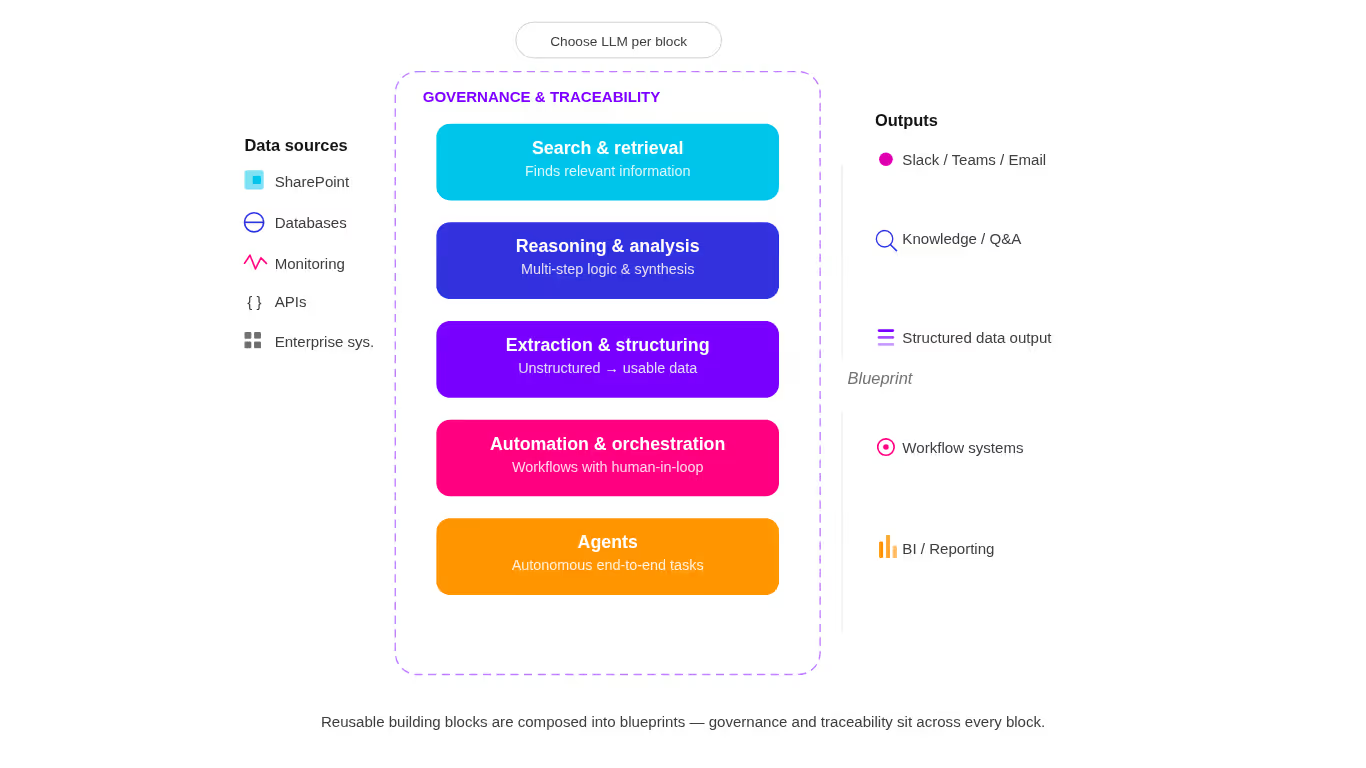
This approach breaks AI functionality into independent, reusable components that can be assembled, configured, and deployed to solve specific business problems. Instead of building monolithic systems from scratch, enterprises compose solutions from pre-built building blocks like search, reasoning, extraction, automation, and agents.
Generic tools force your business to adapt to them, creating more workarounds than usual. Custom builds require ground up development for each use case. Monolithic platforms lock you into a single vendor's approach and make every change a risk. The outcome is solutions that fit your business, deployed fast, built on components that improve over time.
Why monolithic AI architectures fail at scale
The pattern repeats across every enterprise. You start with one AI project. It takes 12 to 18 months. Custom infrastructure, custom integrations, custom everything. It works, eventually.
Then comes the second use case. And the third. Each requires similar infrastructure, similar integration work, similar governance setup. But none of it transfers. Every project starts from zero.
Monolithic systems break for predictable reasons. Components built for one project can't serve others. Coupled dependencies means changing one part risks breaking everything. Scaling multiplies costs instead of decreasing them. Your ten use cases means ten times the infrastructure and maintenance.
And let’s not forget that knowledge concentration is fatal as only the team that built it understands it. Even if you’re able to find tribal knowledge, you still have to deal with model lock-in since you're tied to the LLM that was current when you started building, while the landscape evolves around you.
The math simply doesn't work. If one AI project takes 12 months and you have 50 potential use cases, you're looking at 50 years of development. Or you need an architecture that lets you deploy the second use case in weeks, not months.
The building blocks of enterprise AI
Modular AI platforms decompose AI capabilities into discrete, purpose built components. Each building block handles a specific function and can be combined with others to create complete solutions. Let’s take a look at some core functionality that can serve many desired outcomes.
Search and retrieval. Finds relevant information across structured and unstructured data. Connects to documents, databases, APIs, and enterprise systems. Powers knowledge on demand, Q&A, and research workflows.
Reasoning and analysis. Applies logic to retrieved information. Compares, evaluates, and synthesizes across sources. Handles multi step problem solving that goes beyond simple retrieval.
Extraction and structuring. Transforms unstructured content into usable data. Identifies entities, clauses, numbers, and relationships. Maintains traceability back to source for audit and compliance.
Automation and orchestration. Connects reasoning to action. Triggers workflows in downstream systems. Handles multi step processes with governance and human in the loop controls where needed.
Agents. Autonomous capabilities that complete tasks end to end. Combine multiple building blocks with decision logic. Operate within defined guardrails and escalate when appropriate.
The architecture principle matters: each block is independently developed, tested, and improved. New capabilities enhance all solutions that use that block. A better search component automatically improves every solution that includes search. This is how modular platforms compound value over time.
How blueprints assembles building blocks into solutions
Building blocks alone don't solve business problems. They need to be assembled and configured for specific use cases. This is where blueprints come in.
A blueprint defines which building blocks to use and how they connect. It specifies data sources to integrate, which LLM to use for each component, governance rules and guardrails, and output formats and destinations. The blueprint is a spec file that orchestrates everything needed for a complete solution.
Consider a document extraction solution. The blueprint specifies: ingestion block connects to SharePoint, extraction block identifies contract clauses, reasoning block validates against policy, automation block routes to the workflow system, all using the customer's preferred LLM, with audit logging enabled. That's a complete solution defined in configuration, not code.
Or consider an IT operations assistant. The blueprint specifies: search block connects to ticketing, monitoring, and knowledge base systems, reasoning block correlates incidents with playbooks, agent block suggests resolutions, automation block updates tickets, with human in the loop approval for critical actions. Same building blocks, different configuration, different solution.
This is why blueprints matter. Same building blocks, different configurations, different solutions. No custom code required to assemble new use cases. Solutions inherit improvements to underlying components. Governance and compliance are built into the configuration layer, not bolted on afterward.
Choosing a modular AI platform: What to look for
Not every platform that claims modularity delivers it. Here's how to evaluate.
True modularity. Are components genuinely independent, or is it marketing language on a monolithic system? Can you use different LLMs for different components? Do improvements to one component benefit all solutions that use it?
Pre-built integrations. Does the platform connect to your existing systems out of the box? How long do new integrations take? Are connectors maintained by the vendor or do they become your problem?
Configuration vs coding. Can solutions be configured without custom development, or is engineering required for every use case? How are blueprints created and modified? What happens when requirements change?
Governance and security. Is governance built into the architecture, or bolted on as an afterthought? Can solutions run on prem, private cloud, or your preferred environment? Does data stay within your perimeter?
Vendor trajectory. Is the platform continuously improving? Do new AI capabilities get added to building blocks automatically? Are you locked into today's technology, or positioned for tomorrow's advances?
Red flags to watch for: "Modular" marketing with monolithic architecture underneath. Requires custom development for every use case. Single LLM dependency with no flexibility. No on prem or private cloud option. Governance treated as optional.
The architecture that scales
Modular AI platforms represent an architectural shift from building AI systems to assembling them. Instead of 12 month projects that produce one solution, enterprises deploy multiple solutions in weeks, each configured from reusable components that improve over time.
The question isn't whether your enterprise needs AI. It's whether you can afford to build every solution from scratch. Modular architecture makes the math work: dozens of use cases without dozens of development teams, without multiplying infrastructure, without starting over every time.
As AI capabilities advance, modular platforms absorb those advances into building blocks. Your solutions get smarter without rebuilding them. That's not just faster deployment. It's sustainable AI at enterprise scale.
See modular AI architecture in action. Explore the Unframe platform or book a demo to configure your first solution from building blocks.





.svg)