
Every great story has a duo - Sherlock needs Watson, Maverick needs Goose, and Enterprise AI needs Data Mesh. One brings the brains and ambition, the other the backbone and discipline. Without that partnership, the plot always ends the same: failure. We’ve seen this play out across many of our customers, from financial services to telco to supply chain. The pattern is always the same: AI without strong data foundations promises brilliance but stalls in practice.
Key Takeaways
- Enterprise AI initiatives don’t fail because of weak models. They fail because of weak data foundations.
- Data mesh decentralizes ownership and treats data as a product, enabling high-quality, contextual, and accessible data for AI.
- Centralized architectures hit scale, context, and trust limits, creating bottlenecks for enterprise AI.
- Distributed, domain-driven data architecture makes AI repeatable, reliable, and scalable across the enterprise.
- Enterprises that treat data with the rigor of code and infrastructure will lead the AI revolution.
Enterprises today are investing heavily in AI - automating decisions, personalizing customer experiences, and uncovering new revenue streams. But why do we see many initiatives stalling? Across dozens of large-scale client projects, we’ve observed a trend: AI doesn’t fail because the models are weak - it fails because the data foundation is fragile.
Centralized data warehouses and monolithic platforms promise order but often deliver bottlenecks. Teams are left with fragmented, low-quality, or inaccessible data.
Data mesh: the missing operating model
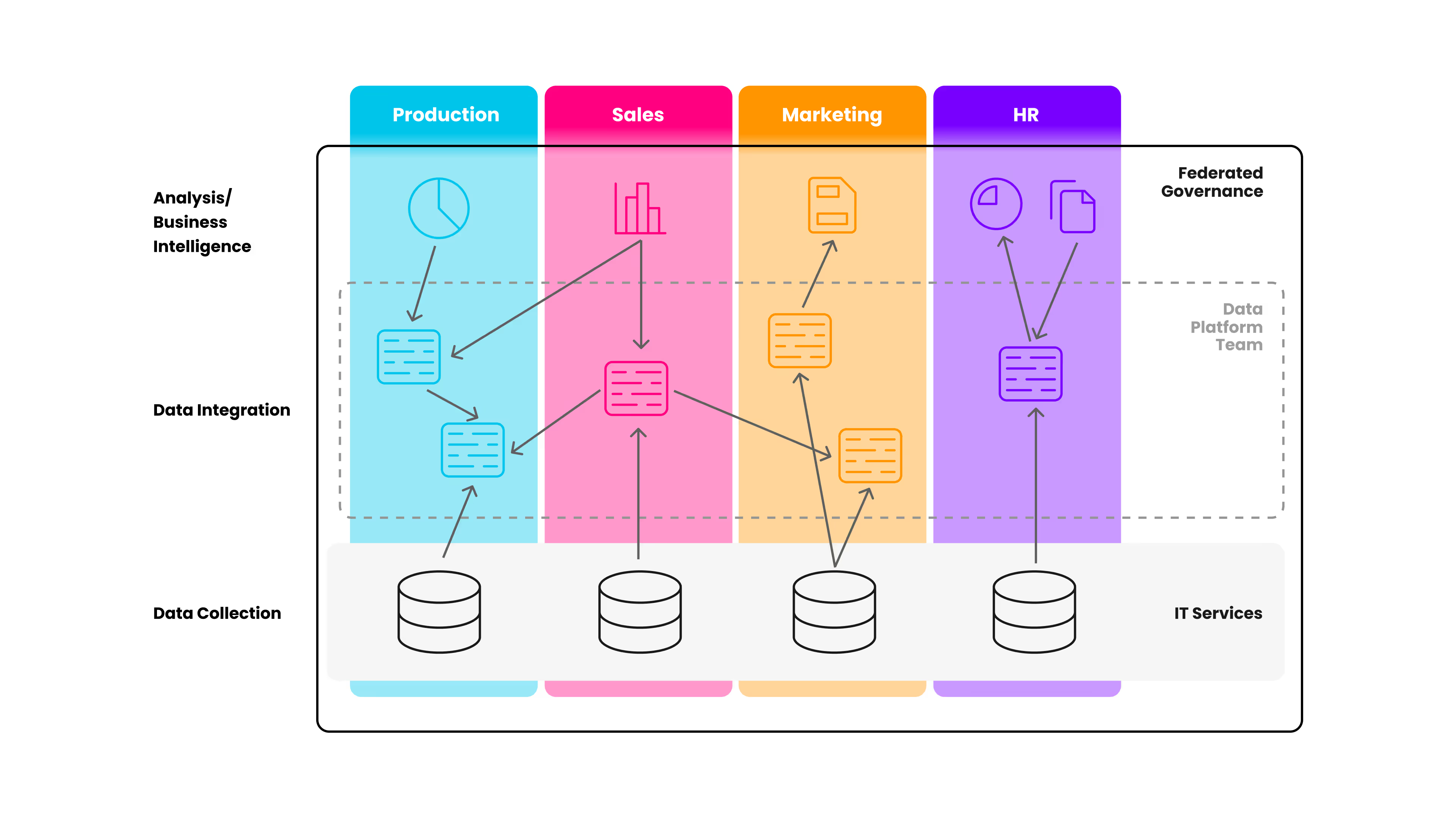
Data mesh changes the game. Instead of treating data as an afterthought or a byproduct of applications, Data Mesh makes data a first-class product, owned by the teams that generate and understand it best. It decentralizes ownership, but enforces interoperability and standards; this creates a system where data can flow seamlessly across domains.
For AI, this is not optional. Models demand high-quality, contextual, and continuously refreshed data. Without a mesh, data scientists spend 70% of their time cleaning, reconciling, and requesting other teams for access. With a mesh, the focus shifts to what matters most - building AI that delivers real business impact.
Data mesh in action
This isn’t theory - we’ve seen distributed architecture take shape in some of the world’s most complex organizations.
- Banking: Federated KYC and transactions datasets accelerate fraud detection while staying compliant with Basel III and AML.
- Life Sciences: Clinical and R&D teams curate patient and trial data products, enabling pharmacovigilance and discovery.
- Telco: Operations expose telemetry and churn signals as reusable products, powering service quality and customer experience models.
Different industries, same outcome: treat data as a product, keep it close to the experts, and AI becomes repeatable, scalable, and trusted.
But why do these successes matter? Because the traditional alternative consistently breaks down when scaled.
Why centralized models fail in enterprises
Traditional centralized data approaches - lakes and warehouses - consistently hit three walls when scaled for enterprise AI.
Visualize three stacked horizontal blocks:
- Scale
- Context
- Trust
Each block has a short caption:
- “Can’t keep up with enterprise-wide demand”
- “Meanings get lost across domains”
- “No ownership, no accountability for data quality”
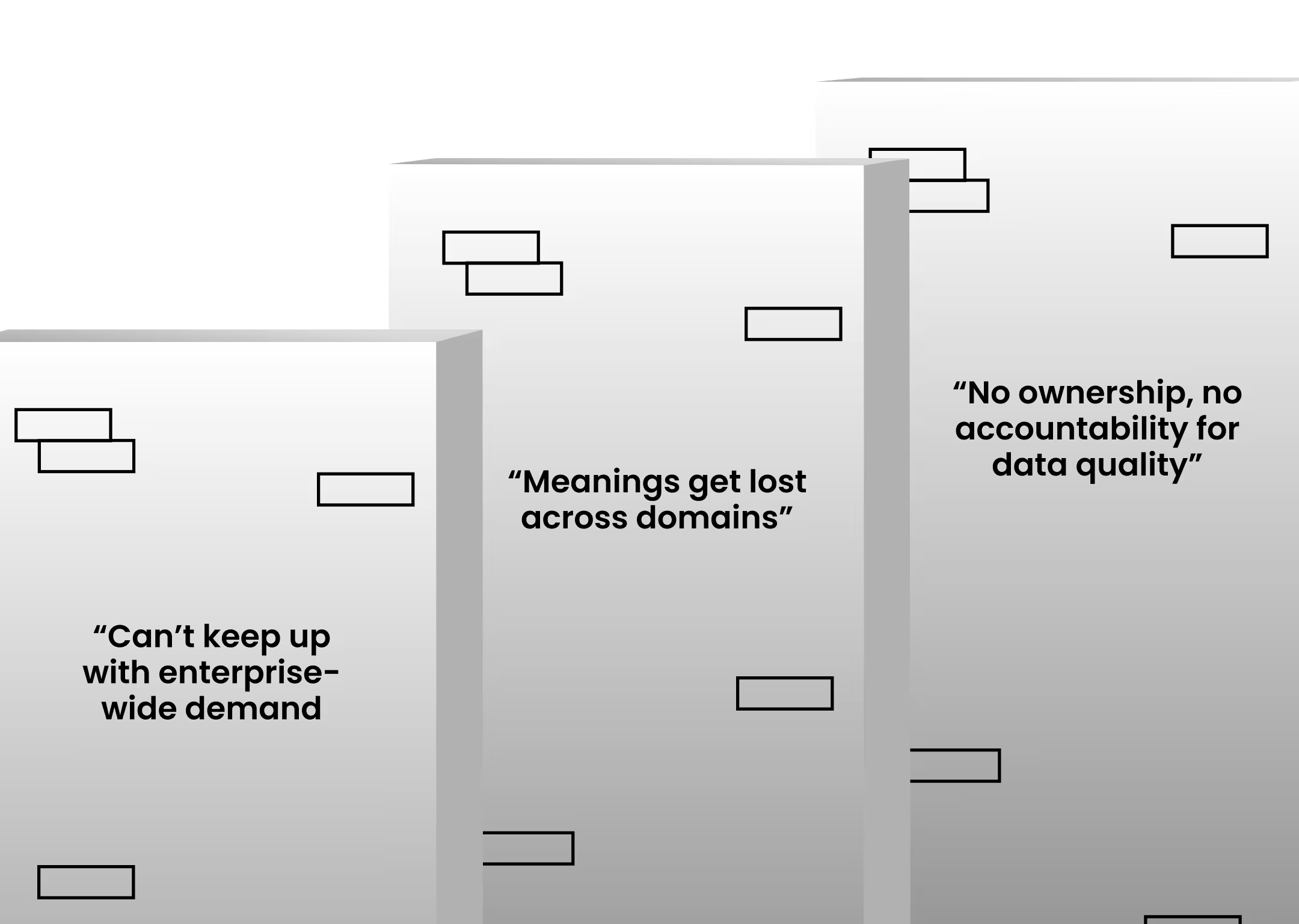
The Scale wall: A central team can’t possibly keep up with the pipeline of new AI use cases across every business unit. The architecture simply doesn’t scale.
One global retailer hit this wall when its centralized data team became the bottleneck for dozens of AI initiatives - from demand forecasting to supply chain optimization. Business units had ideas ready to go, but the wait time for data pipelines stretched into months. AI progress froze, not because the models were weak, but because the foundation couldn’t keep pace.
The Context wall: A customer “order” means something very different in sales, logistics, or finance. Strip away this domain-driven design context and AI loses accuracy.
The Trust wall: When ownership of data quality is blurred, accountability disappears. AI ends up amplifying bad inputs into bad insights.
If you’ve seen a promising pilot collapse during production rollout, chances are you’ve hit one (or all!) of these walls.
Data mesh as the foundation for enterprise AI
The path forward is clear: enterprise AI will only succeed if it’s built on a distributed, domain-driven foundation.
This means:
- Domain-driven ownership - data remains close to the teams that understand its meaning
- Product thinking for data - each dataset is curated, discoverable, and reliable.
- Federated governance - interoperability is enforced without drowning teams in bureaucracy
- Self-serve platforms on distributed architecture - AI teams can scale use cases without waiting months for pipelines
This isn’t just operational hygiene. It’s a strategic imperative. Data mesh, enabled by distributed architecture, makes AI repeatable, reliable, and real.
Stop building AI castles on data sand
Here’s the hard truth: enterprise AI initiatives that ignore data mesh, distributed architecture, and domain-driven design will fail. They may produce impressive demos, but they won’t scale with the speed, trust, and resilience that the business demands.
To diagnose readiness, technical leaders should ask three questions:
- Ownership: Can we name the accountable owner of every dataset feeding our AI models?
- Productization: Are our data assets curated, discoverable, and reliable like any other product?
- Scalability: Can new AI use cases launch without queuing behind a central data bottleneck?
If the answer is “no” to any of these, the foundation needs reinforcement.
The real AI revolution won’t be about who trains the largest model or buys the most GPUs. It will come from enterprises that treat data with the same rigor as code and infrastructure. Data Mesh is not a “nice-to-have.” It’s the foundation. Without it, AI doesn’t fail because of algorithms, but because of the ground it stands on.
Where Unframe stands
At Unframe, our solutions are built on the principles that make enterprise AI succeed: data mesh to decentralize ownership, distributed systems for scale, and domain-driven design to keep AI systems aligned with your business.
- Data is treated as a product
- Ownership stays close to domain teams
- Systems scale reliably across the enterprise
The result is AI that doesn’t sit in silos or stall after a proof-of-concept, but adapts to evolving needs and delivers measurable business impact at scale. Because the only AI worth building is the kind that lasts.





.svg)